Veneers vs. Implants: Which One Does Your Smile Actually Need?
Frequently Asked Questions
Veneers and implants fix different problems: veneers change how a healthy tooth looks, and implants replace a tooth that's missing or can't be saved. Whether your natural tooth is still there and worth keeping decides it, and a short exam with X-rays answers that.
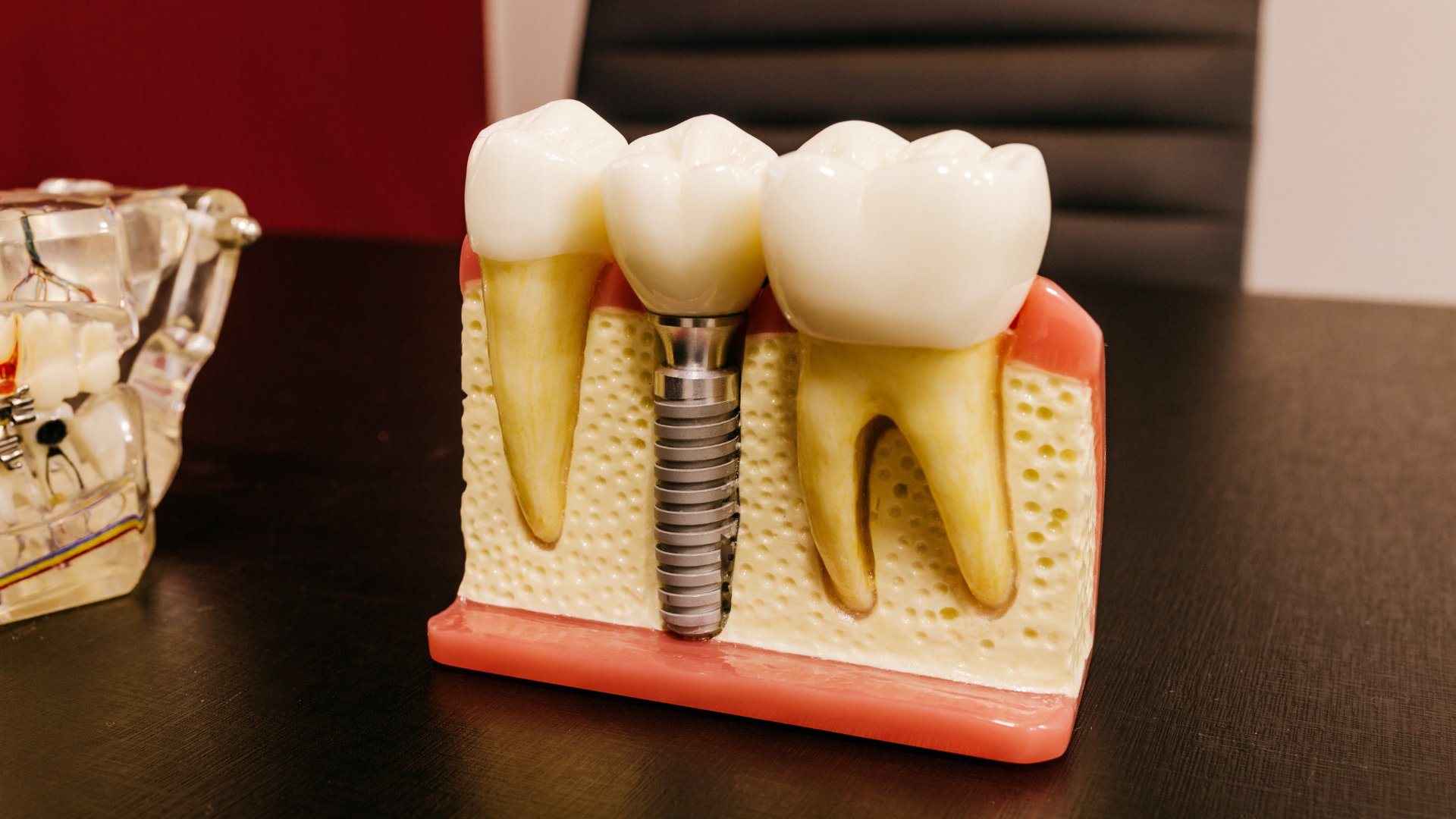
Veneers and dental implants solve different problems: veneers are thin porcelain or composite shells bonded to the front of healthy natural teeth to change their color, shape, or size. Implants replace a tooth that's missing or can't be saved, using a titanium post placed in the jaw to anchor a crown.
Quick answer: Still have a healthy tooth you want to look better? Think veneers.
Tooth gone, or too damaged to keep? That's implant territory.
Key takeaways
- Veneers improve the look of teeth you still have. Implants replace teeth you've lost or can't keep.
- A veneer needs a healthy natural tooth underneath it. An implant needs enough healthy jawbone to hold it.
- Porcelain veneers involve removing a thin layer of enamel, so they're a permanent decision.
- Plenty of smiles call for both: an implant crown in one spot and veneers on the teeth around it.
- With CEREC, veneers at Giant Smiles are often milled in the office and placed the same day.
One question decides it
Should I get veneers or implants? New patients ask me some version of that fairly often, and I get why.
The two show up in the same before-and-after photos, and neither one is a small purchase, so nobody wants to guess.
The honest answer usually has less to do with preference than with what's going on under the surface.
Is the tooth still there, and is it healthy enough to keep? Once we know that, the choice mostly makes itself.
If a missing or failing tooth is what brought you here, our dental implant services page covers how we approach tooth replacement in Manhattan Beach.
What's the real difference between veneers and implants?
A veneer is a covering, and an implant is a replacement.
Veneers are thin shells bonded to the front surface of a natural tooth to change its color, shape, or size. Implants replace the whole tooth with a post set in the jawbone that holds a crown.
You keep your tooth with a veneer; with an implant, it's already gone.
The American Dental Association describes veneers as custom-made shells that
cover only the front surface of a tooth, rather than the whole tooth the way a crown does. The ADA also points out that the treatment isn't reversible, which is why it should only be done by a licensed dentist (ADA MouthHealthy: Veneers).
Implants work at a different level. The ADA describes them as surgically placed anchors in the upper or lower jaw, made of titanium and other materials, that hold crowns or bridges as a long-term way to
replace a missing tooth (ADA MouthHealthy: Ways to Improve Your Smile).
How do you know which one you need?
Start with the tooth itself. If it's still in place, structurally sound, and sitting in healthy gums, veneers are on the table.
If it's missing, cracked below the gumline, or failing, a veneer has nothing solid to hold onto, and replacement becomes the conversation. An exam and X-rays settle which situation you're in.
Veneers usually make sense when the tooth is healthy but you don't like how it looks:
- Stains or a gray cast that professional whitening can't lift
- Chipped or worn edges
- Small gaps between the front teeth
- Teeth that are uneven, slightly crooked, or oddly shaped
The ADA's patient guidance lists these same concerns, noting that veneers can lighten front teeth that don't respond to bleaching and correct teeth that are chipped or worn (JADA patient page).
An implant becomes the likely answer when:
- A tooth is already missing
- A tooth is cracked or broken too far to repair
- A tooth needs to come out because of infection or damage
Before any of that, though,
veneers don't fix decay or gum disease. Those get treated first.
The ADA notes you can still get cavities under or around a veneer, so the foundation has to be healthy before anything goes on top of it.
Sometimes the answer is neither
Some teeth land in between. A tooth with a large old filling, or a crack that hasn't reached the root, can be too weak for a veneer and still worth saving.
That's usually crown territory, sometimes after a root canal. A crown covers the whole tooth instead of just the front, which is the same line the ADA draws between the two.
I bring it up because people sometimes arrive set on one of the two options in the title when a third one fits better. [DR. RAY: confirm he's comfortable including crowns here]
Veneers vs. implants: how do they compare side by side?
Veneers are cosmetic and non-surgical, usually placed on front teeth, and permanently change the enamel beneath them. Implants are surgical, can go anywhere in the mouth, and involve a healing period before the final crown goes on.
Both look natural when done well, and both need everyday brushing, flossing, and checkups to last.
If you're skimming, this table is the short version.
| Veneers | Dental implants | |
|---|---|---|
| What it does | Changes the color, shape, or size of a tooth you already have | Replaces a tooth that's missing or can't be saved |
| What you need | A healthy natural tooth and healthy gums | Enough healthy jawbone to anchor the post |
| Surgery involved? | No | Yes, the post is placed in the jaw |
| Visits at Giant Smiles | Often just one, using CEREC | Several, with healing time in between [DR. RAY: confirm typical number of visits] |
| Effect on the natural tooth | A thin layer of enamel is removed for porcelain veneers | Replaces the tooth entirely |
| Daily care | Brush and floss as usual, go easy on coffee, tea, and red wine, and avoid chewing hard objects | Brush and floss around the implant crown and keep up with regular cleanings |
How well do implants hold up? A 2025 study in the Journal of Oral Biology and Craniofacial Research followed 161 implants for five years and found that 92.5% were still in place and functioning.
Implants in patients without diabetes or hypertension fared better, and the authors flag smoking and overall health as factors to weigh before surgery (Mahendra et al., 2025). It's one clinic's data, so I'd read it as encouraging rather than guaranteed.
Porcelain veneers are strong and long-lasting, according to the ADA, but they can still chip. Biting your nails, chewing ice, or skipping a mouthguard during sports will do it, the same as with a natural tooth.
Can you have both veneers and an implant?
Yes, and the two often work together. Say a front tooth is lost to an injury and the teeth beside it are stained or chipped.
An implant crown replaces the missing tooth, and veneers on the neighbors bring everything to the same shade and shape. Planning both together is what keeps the final smile from looking patched.
You can't really put a veneer on an implant, though. The implant is topped with a crown that covers the entire visible tooth, so the crown is shaded and shaped to match the surrounding veneers. [DR. RAY: confirm whether implant crowns are also milled in-office with CEREC]
Timing matters here, too. The ADA notes that whitening won't work on caps, veneers, crowns, or fillings (ADA MouthHealthy: Teeth Whitening).
So if you want your natural teeth brighter, it's worth doing that before we match the shade of any new crowns or veneers.
What does each process look like at Giant Smiles?
Veneers can often be finished in a single appointment here, because we design and mill them in the office with CEREC technology instead of waiting on an outside lab. Implants take longer by nature.
The post needs time to fuse with the jawbone before the final crown is attached, so treatment happens in stages.
Same-day veneers with CEREC
I'm a certified trainer in CEREC same-day dentistry, which combines a digital camera, design software, and an in-office milling unit. Instead of impression trays, we take a digital scan of your teeth and design each veneer on screen.
The unit then mills it from a block of tooth-colored ceramic while you wait, and we bond it in place during the same visit. You don't wear a temporary, and there's no second appointment to schedule.
If you'd like the full walkthrough, here's how our same-day veneers work.
The implant process
Implants follow a staged path. It starts with an exam and imaging to check the bone and plan placement.
Next, the post is placed in the jaw and given time to integrate with the bone. Once it's stable, an abutment and custom crown are attached.
Frequently Asked Questions
Should I get veneers or implants for a missing front tooth?
An implant, or another tooth-replacement option such as a bridge. A veneer needs a natural tooth to bond to, so it can't fill a gap.
If the neighboring teeth are discolored or uneven, veneers on those teeth can be paired with an implant crown so everything matches.
Are veneers or implants more expensive?
It depends on how many teeth are involved and what each one needs. An implant replaces the whole tooth and involves surgery, while veneers are often placed on several front teeth at once.
The only reliable comparison is a consultation that prices out your specific plan.
Can you put a veneer on a dental implant?
Not in the usual sense. An implant is topped with a crown that covers the entire visible portion of the tooth, so it doesn't need a veneer.
That crown can be shaded and shaped to match veneers on the natural teeth around it, which is how we keep a smile looking even.
Do veneers damage your natural teeth?
Porcelain veneers usually require removing a thin layer of enamel, which is why the ADA describes the treatment as irreversible. That makes a careful exam and an experienced dentist important before you commit.
Composite veneers may need less preparation, depending on the tooth.
What's the difference between veneers and implants in plain terms?
Veneers change how a healthy tooth looks by covering its front surface. Implants replace a tooth that's gone or can't be saved, anchoring a new crown in the jaw.
One improves a tooth you have, and the other replaces one you don't.
From the chair: Dr. Gregory Ray
Gregory Ray, D.D.S., founded Giant Smiles Dental in Manhattan Beach after more than a decade in practice in San Diego and a period on Manhattan's Upper East Side in New York. He earned his dental degree from the University of the Pacific School of Dentistry in San Francisco.
Dr. Ray is a Fellow of the
International Congress of Oral Implantology, a certified trainer in CEREC same-day dentistry, and a member of the American Academy of Cosmetic Dentistry.
He's licensed in California and sees patients from Manhattan Beach, Hermosa Beach, and Redondo Beach at 500 S Sepulveda Blvd, Suite #305.
Not sure which one you need?
It comes back to the tooth: keep it and improve it, or replace it. An exam with X-rays tells us which.
Schedule a visit at Giant Smiles Dental in Manhattan Beach, or call us at (310) 219-6262
Disclaimer: This article is for general educational purposes and isn't a substitute for personal dental advice. If an aligner is damaged or doesn't fit, or you have questions about your treatment, please contact your dentist.
New Title